









Helping Your Boyfriend game cover

Browser Game

Helping Your Boyfriend

A horror romance visual novel by Zieelane and Mousefishdog. Warning: violence, gore, flashing imagery, jump scares, and toxic relationships.

Home Is Where He Is game card

Browser Horror

Home Is Where He Is

Cobb Can Move game card

Survival Horror

Cobb Can Move

Kingdom of Marionettes game card

Puppet Theater

Kingdom of Marionettes

Jackpot Crash Course game card

Casino Death Game

Jackpot Crash Course

Blood Money 2 game card

Dark Simulation

Blood Money 2

TADC Dating Sim game card

Romance Visual Novel

TADC Dating Sim

Survive Min game card

Psychological Horror

Survive Min

The False Sun game card

Farm Horror

The False Sun

Temple of the Jackal game card

Adult Pixel Puzzle

Temple of the Jackal

Uncanny Cat Golf game card

Surreal Mini Golf

Uncanny Cat Golf

Frankie's Fun House game card

Point-and-Click Mystery

Frankie's Fun House

Death Spiral game card

One-Button Horror

Death Spiral

The Coffin of Andy and Leyley game card

Sibling Horror

The Coffin of Andy and Leyley

Dracula Drop game card

Vampire Action

Dracula Drop

The Choicer Voicer game card

Microphone Party

The Choicer Voicer

Over Dose game card

Psychological Visual Novel

Over Dose

Helping Your Boyfriend game card

Horror Romance

Helping Your Boyfriend

Original Guide

About Helping Your Boyfriend

When Living Together Stops Feeling Familiar

Helping Your Boyfriend begins from an intimate arrangement rather than a journey into an unfamiliar wilderness. Your character lives with Adrian, a doctor and their boyfriend. A leg condition means the protagonist cannot walk, placing everyday assistance within the relationship's ordinary rhythm. Waking during the night changes that rhythm. Requests arrive, explanations become important, and the home becomes a place where familiarity alone cannot settle what is happening. The game is a horror romance visual novel created by Zieelane and Mousefishdog, and its affectionate surface should be approached with its horror warnings firmly in mind.

For this Home Is Where He Is guide, the central reading question is what makes a shared space feel like your own. A comfortable room is not necessarily a room where you can ask questions, change your mind, or refuse a favor. Conversely, receiving help does not automatically remove a person's independence. Keep these ideas separate as you read. The protagonist's disability is a circumstance of the story, not an explanation for why coercion should be accepted. Watch how people respond to the character's wishes, not merely how often they describe themselves as helpful.

The illustration here is supplied brand artwork, showing a blond doctor beside the game's pink title. It should not be treated as a screenshot documenting a story event. The contrast between its welcoming design and the genre is a useful invitation to read carefully, but it does not reveal a route. This page offers an embedded player and an original spoiler-light companion, not an official walkthrough. Browser compatibility, complete playability, and parity with the creator's release have not been established through a playtest here.

Helping Your Boyfriend brand illustration showing a blond doctor with a folder beside pink lettering and hearts

Set Your Own Pace Before Entering the Story

Content warnings include violence, blood and gore, flashing imagery, jump scares, and toxic relationships. A pink interface and romantic dialogue do not cancel those warnings. Decide whether you want to continue before launching, and remember that optional images and videos can disclose scenes even if the surrounding guide avoids detailed outcomes. You do not owe a horror game a finished route. Pausing, lowering the sound, leaving fullscreen, or stopping entirely are reasonable ways to control a session rather than signs that you have played incorrectly.

Click Play Now to request the remote browser build, then let its assets load before repeatedly pressing buttons. Once it responds, inspect the visible menu and settings. The described interface uses a bell at the top for save, load, and settings access. See what is actually available in the hosted version instead of assuming that a guide's description guarantees an identical menu. If manual saves are offered, make a reference save at a calm moment and verify that a slot appears before relying on it for a later experiment.

Plan a first session around understanding the opening rather than collecting everything. The official project advertises four endings and five minigames, but a number is not a deadline. Trying to optimize immediately can turn every sentence into an imagined scoring rule and make the relationship harder to read. Choose an unhurried pace, keep the first video closed, and allow your initial response to be imperfect. A remembered surprise is often more useful for a second reading than a route completed by copying instructions whose assumptions you cannot check.

Dialogue Choices as Small Boundaries

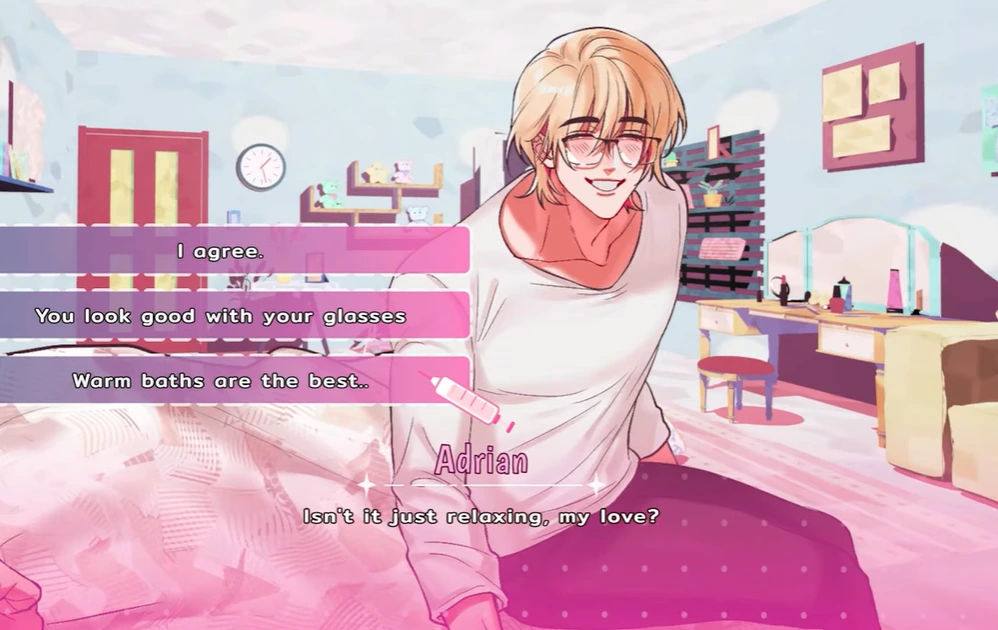
A conversation inside a shared bedroom can feel low stakes because the surroundings are familiar. The supplied scene beside this section shows Adrian wearing glasses and several pink response options. It demonstrates how a choice can sit inside an apparently ordinary exchange, not which answer you should select. Before responding, ask what your character would be doing socially: agreeing, offering a compliment, redirecting attention, or expressing a preference. Reading the available words this way preserves their emotional meaning without inventing an invisible affection meter.

The official description includes name, pronoun, and body-type customization. These options can make the protagonist feel more personally situated, but there is no verified claim here that a particular name or identity changes an ending. Use customization for the perspective you want to inhabit. Then try to give that perspective a recognizable voice. A cautious person can still be affectionate, and an affectionate person can still ask for an explanation. You do not need to choose between blanket suspicion and automatic agreement in order to have a coherent first playthrough.

After a response, pay attention to what is acknowledged and what is ignored. A character might answer the literal question while avoiding its underlying concern, or offer comfort without giving new information. These are possible patterns to look for, not statements that every exchange follows them. Keep the exact dialogue as your evidence. If you need to review it, use the history function rather than filling the gap with a stronger accusation or reassurance than the game actually supplied. Ambiguity remains more interesting when it is grounded in specific words.

Adrian in glasses beside a bed with three pink dialogue options over a pastel bedroom scene

Helping with Dolls Is Also Participating

Helping Adrian dismantle old dolls is part of the supplied premise. A favor can sound simple in dialogue, but a minigame makes your participation physical: you must move the pointer, handle an object, or follow an instruction. That change of input can alter the emotional texture of the scene. Rather than deciding immediately what the dolls symbolize, examine the request's practical framing. Who says what needs doing? Is a reason given? What does the protagonist understand at the moment they are asked to help?

Mouse dragging is one of the described controls. Read each task's own prompt before moving anything, then try a deliberate motion and watch the feedback. A missed drag is not necessarily a narrative refusal, and completing an action is not automatically proof that you made the safest story choice. Those are different kinds of result. This guide does not supply invented target positions, hidden deadlines, or task-to-ending rules. If an interaction remains unclear, write down the visible instruction so a later attempt tests that instruction rather than a vague memory of it.

The domestic setting makes the word help worth noticing. It can describe generous cooperation, but it can also make a request sound obligatory before its purpose has been explained. That is an interpretive tension, not a universal judgment about Adrian's every action. Compare the character's language with the options the protagonist appears to retain. A request that leaves room for questions feels different from one that treats questions as disloyalty. Let actual scenes determine which reading fits, and leave space for a later route to complicate your initial view.

A Doctor, a Stranger, and Conflicting Instructions

Adrian's profession adds another layer to the relationship because a doctor can appear knowledgeable in situations the protagonist cannot easily evaluate. The supplied portrait shows his white coat, a black glove, and a relaxed smile against pink scenery. Those visual details can communicate confidence, but they are not independent evidence that every statement is accurate. While reading, distinguish what a character knows from what the story has allowed you to confirm. Expertise, affection, and access to the household can overlap without becoming the same source of trust.

The premise introduces a stranger at night who threatens the protagonist and demands that medication be given. A demand from outside the couple does not become trustworthy merely because it challenges the familiar boyfriend. The scene creates competing pressure, and pressure can make a narrow set of actions feel unavoidable. A useful reading method is to identify each speaker's request, claimed reason, and possible leverage. You can compare those elements without deciding prematurely that one person must be a reliable narrator and the other must explain every danger.

Medication in this fictional scenario should stay within narrative analysis. This page provides no instructions about drugs, doses, or treatment. The relevant questions concern agency and responsibility: who must perform the requested act, who gets an explanation, and who is exposed to the consequences? If you replay the encounter, compare the dialogue and observable response rather than claiming that a particular medical action always produces a named ending. Without verified route evidence, such a claim would turn a disturbing story situation into a misleading walkthrough.

Adrian smiling with a black-gloved hand near his face while wearing a white coat and striped tie

Make the Interface Work for Your Reading

Click or Enter advances text, Space hides dialogue, L opens the history, and A starts automatic advancement. Ctrl or Tab is used to skip. Learn these distinctions during a quiet exchange. If text disappears, first check the hide function instead of reloading and losing your place. If it moves too quickly, inspect automatic reading or skipping before assuming a scene is broken. On an unfamiliar route, manual advancement gives you time to connect a line with the expression or image accompanying it.

Quick-time events use direction keys and Space according to the supplied control list. Space can therefore have a different role when a timed prompt is active than when you are simply reading. Follow the current on-screen instructions, and click inside the frame before using the keyboard. If a direction key moves the surrounding page, the browser may not have assigned focus to the game. Changing focus is a practical troubleshooting step; it does not tell you anything about which outcome the story expects.

A keyboard and pointer provide the clearest match to these described controls. Touch may be sufficient for some dialogue but should not be assumed to replace every dragging action or keyboard event. This guide does not promise completion on a phone. Likewise, saving in one browser does not establish cloud synchronization or permanent storage. Avoid clearing site data while troubleshooting progress, and keep a brief external note of the scene and slot you intended to preserve. That note documents your own session without pretending to know the game's storage implementation.

Return to the House with Better Questions

A finished route gives you context, not necessarily an explanation of every rule. The creator's advertised four endings can encourage replay, but this hosted edition has not been checked for all of them. Start a second reading with one question you can actually investigate. Perhaps you want to compare a response to hesitation, the explanation behind a task, or the moment a reassuring phrase stops feeling sufficient. A focused question produces more useful observations than changing every choice and then guessing which alteration caused the final result.

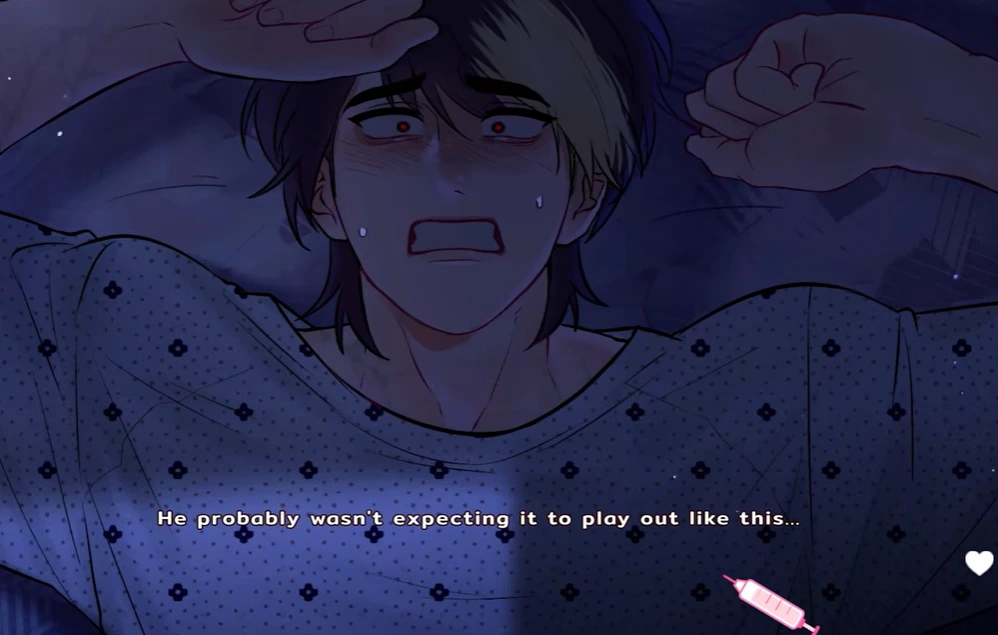
Keep the first route's notes intact. Record the save used, the choice you changed, and the next clearly different event. If a later scene appears unchanged, say only that you did not observe a difference there. Avoid converting absence of immediate feedback into certainty that an earlier decision is irrelevant. The dark screenshot beside this discussion shows a frightened character lying on a pillow; it is a supplied scene, not an ending label or evidence that a particular answer leads to it. Images should support attention, not substitute for route verification.

The two videos below are optional reference material and may reveal outcomes. Watch after your own first route if discovery matters to you. Version differences, editing, and omitted choices can make a video difficult to reproduce even when its footage is genuine. Finally, if the embedded game will not load, allow time for the remote host, refresh once, and consider whether a network or extension blocks third-party frames. Source integration is not a production playtest. Keep technical uncertainty separate from narrative mystery, and do not mistake a loading failure for part of the horror.

A frightened character with raised hands lies on a pillow in a dark blue nighttime scene

Helping Your Boyfriend Videos

Helping Your Boyfriend FAQ

Who are the creators?

Helping Your Boyfriend is by Zieelane and Mousefishdog. This is an independent play-and-reading page, not an official developer announcement.

What is the starting situation?

The protagonist lives with their doctor boyfriend Adrian and cannot walk because of a leg condition. Waking at night leads into disturbing requests and uncertainty inside the shared home.

How many endings and minigames are described?

The official project advertises four endings and five minigames. Those counts have not been verified through completion of this browser build.

Which protagonist details can be changed?

Name, pronouns, and body type are included in the official feature description. Check the hosted build for its available options rather than assuming full parity.

How can I reread a missed line?

Use L for dialogue history. Click or Enter advances, while Space hides the dialogue display. Try the history before reloading a scene.

What are the automatic and skip controls?

A enables automatic advancement. Ctrl or Tab skips. Read unfamiliar scenes manually when you want to preserve context and notice changes.

How do physical tasks work?

The described inputs include mouse dragging and direction keys plus Space for quick-time events. The active prompt matters, and the iframe needs keyboard focus.

Where can I save or change settings?

Look for the top bell in the game interface. Inspect its save, load, and settings options early; automatic saving and cross-device persistence are not promised here.

Is this a gentle romance game?

No. It includes warnings for violence, gore, flashing imagery, jump scares, and toxic relationships. Decide whether those themes suit you before starting.

Can I use this page as an exact ending walkthrough?

No. The article offers observation and replay methods without claiming verified ending triggers. Optional videos and images may still contain spoilers.