







By Demonward. A linear kinetic visual novel, approximately 1,000 words / 5 minutes. Implied violence, poisoning, exclusion, black humor. Unofficial third-party browser build; official release is desktop.

Best Friends for Dinner game cover

Browser Game

Best Friends for Dinner

By Demonward. A linear kinetic visual novel, approximately 1,000 words / 5 minutes. Implied violence, poisoning, exclusion, black humor. Unofficial third-party browser build; official release is desktop.

Reading preparation checklist

Independent page tool. No game connection or saved progress; resets on refresh.

0 of 4 preparation items checked. Your comfort remains your decision.

Continue to the reading guide
Home Is Where He Is game card

Browser Horror

Home Is Where He Is

Cobb Can Move game card

Survival Horror

Cobb Can Move

Kingdom of Marionettes game card

Puppet Theater

Kingdom of Marionettes

Jackpot Crash Course game card

Casino Death Game

Jackpot Crash Course

Blood Money 2 game card

Dark Simulation

Blood Money 2

Suzy Says game card

Rule-following Horror

Suzy Says

TADC Dating Sim game card

Romance Visual Novel

TADC Dating Sim

Survive Min game card

Psychological Horror

Survive Min

The False Sun game card

Farm Horror

The False Sun

Temple of the Jackal game card

Adult Pixel Puzzle

Temple of the Jackal

Uncanny Cat Golf game card

Surreal Mini Golf

Uncanny Cat Golf

Frankie's Fun House game card

Point-and-Click Mystery

Frankie's Fun House

Death Spiral game card

One-Button Horror

Death Spiral

The Coffin of Andy and Leyley game card

Sibling Horror

The Coffin of Andy and Leyley

Dracula Drop game card

Vampire Action

Dracula Drop

The Choicer Voicer game card

Microphone Party

The Choicer Voicer

Over Dose game card

Psychological Visual Novel

Over Dose

Helping Your Boyfriend game card

Horror Romance

Helping Your Boyfriend

Odio el Chocolate game card

Exploration horror

Odio el Chocolate

You Are Hamster game card

Short horror comedy

You Are Hamster

Best Friends for Dinner game card

Kinetic Horror

Best Friends for Dinner

Original Guide

About Best Friends for Dinner

An Invitation with Uneasy Boundaries

Best Friends for Dinner brings Donna and the wolf Oz into a short kinetic visual novel by Demonward. It is described as approximately one thousand words, with a reading time around five minutes. Here on Home Is Where He Is, this companion approaches the work through the idea of belonging: how the promise of company can feel comforting, complicated, or uncomfortable. That is a reading angle for this page, not an additional storyline.

Kinetic means that the narrative is linear rather than a collection of player-selected branches. You are not being asked to optimize affection, discover a hidden response, or build a perfect relationship through a series of decisions. The practical aim is to follow the story at a comfortable pace. Any change in your interpretation belongs to your experience as a reader, not to a secret game system supplied by this website.

This distinction matters if you arrived expecting a romance route guide. We do not label a good ending, a bad ending, or a rescue path, and we do not invent a choice sequence. Instead, the page offers preparation, version information, questions for reflection, and optional visual references. You can use as little of that material as you like. Completing a linear story once is not an incomplete run.

Menu screenshot: Donna stands in a forest wearing a blue dress, with white sheep ears. The left panel lists Start, Load, Preferences, About, and Help. This is the main menu, not a set of story choices.
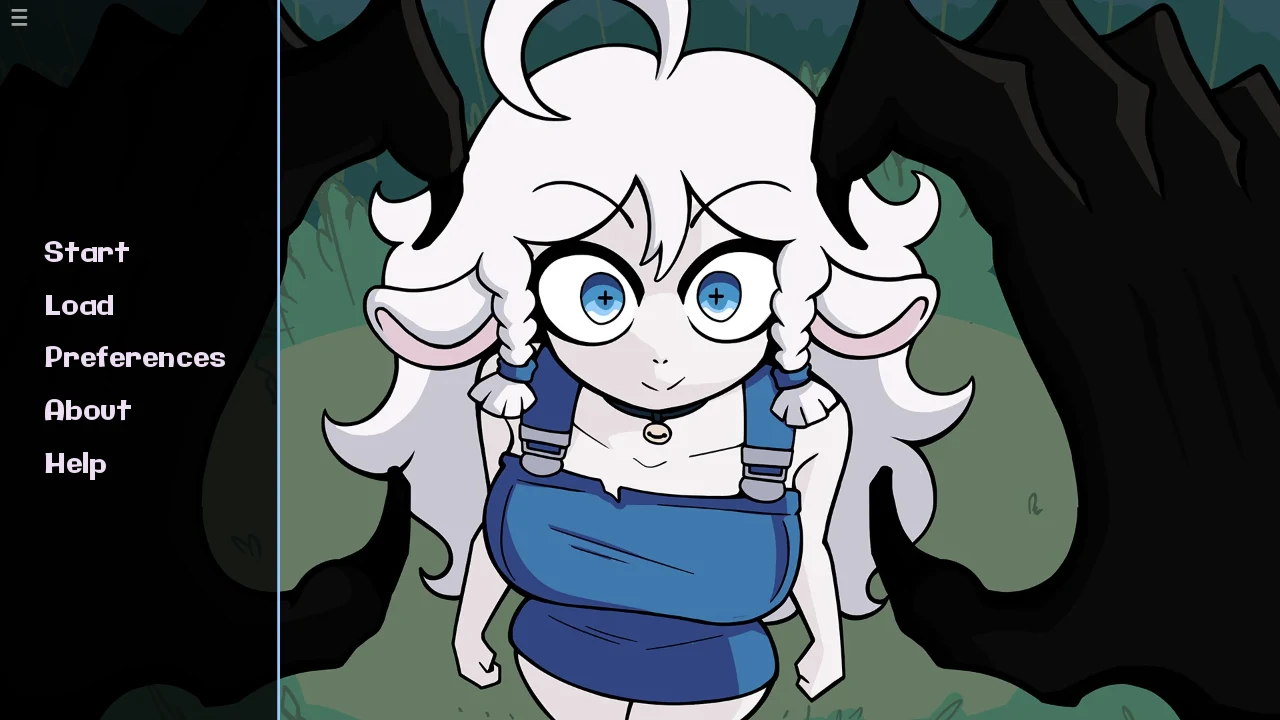
Donna with white sheep ears and a blue dress in a forest beside Start, Load, Preferences, About, and Help.

Make Space for a Comfortable Reading

Before pressing play, review the content themes: implied violence, poisoning, social exclusion, and black humor. A small word count does not measure emotional intensity. If the subject matter is unwelcome, you can stop before loading or leave at any later point. There is no obligation to continue because a story is short, because someone recommended it, or because the title sounds friendly.

A useful preparation routine starts with the reader rather than the game. Find a readable screen position, choose a comfortable volume, and allow more than the approximate five-minute estimate if you prefer a slow pace. If you are in a shared space, consider whether others might see images or hear audio. These are ordinary ways to control your surroundings, not special requirements or verified features of this particular build.

The readiness tool on this page is separate from the fiction. Mark the items that apply to your session and watch the count update. It does not record relationship progress, send decisions to Donna or Oz, or create a saved game. Its state lasts only while this page remains mounted. Leaving an item unmarked has no consequence beyond your own reminder, and the tool never declares that disturbing content must be safe for you.

Understand Which Version You Are Opening

The official game is available as a desktop release. This page instead embeds a user-supplied third-party browser build. We make that distinction before play because a convenient web frame can otherwise look like proof of an official web release. It is not. Authorship remains with Demonward, while the hosting and compatibility of the embedded version are separate matters.

A browser conversion may behave differently from a desktop application, but this guide does not assert specific differences that have not been checked. We have not established equivalent content, identical settings, working saves, or full mobile support. If those features matter to you, inspect what the actual interface offers and avoid relying on a promise made by another edition. An available button is also not proof that its function has been tested here.

The frame loads content from an external host rather than from this site's article text. If it fails, the surrounding navigation or reading guide may continue to work normally. Keep that distinction in mind when reporting a problem. A useful report identifies whether the frame loaded, whether text appeared, and which input failed. It does not need account information, private browsing data, or a copied session token.

Listen to the Language of Friendship

The title foregrounds friendship, which gives a reader a natural question: what expectations come with being called a friend? Bring that question to the words you actually encounter rather than assuming a specific betrayal or resolution. Affectionate language can carry more than one implication, but the text must supply the evidence. A guide should not replace uncertainty with an invented explanation merely because that explanation sounds dramatic.

Donna and Oz are the named characters supplied for this work, and Oz is a wolf. Those facts are enough to orient a first reading without assigning either character a diagnosis, a fixed moral role, or an unverified history. If familiar animal-story conventions shape your expectations, notice that influence. Then distinguish your association from something the visual novel explicitly states or shows.

One practical approach is to pause mentally after a striking line and ask what changed for you. Did the line add information, alter the tone, or make an earlier assumption feel less secure? You can make a short note outside the game if you want, but you do not need to interrupt every screen. The aim is attentive reading, not turning a five-minute story into a worksheet that prevents you from experiencing it.

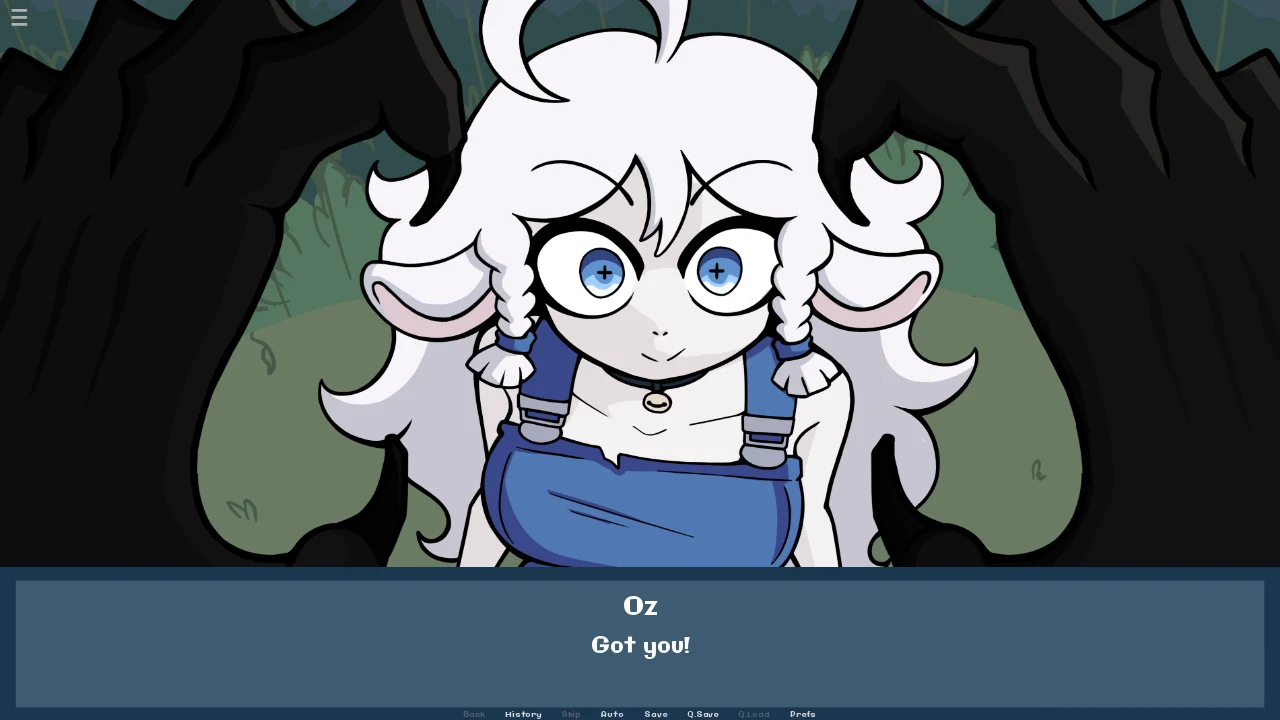
Scene screenshot: Donna is the only visible character, standing with her mouth closed in the forest. The dialogue box is labeled Oz and reads 'Got you!'; Oz has no visible character portrait in this image.

Donna with her mouth closed in the forest; the dialogue box names Oz and reads Got you!

Exclusion and the Desire to Belong

Social exclusion is part of the supplied description. It can be useful to think about belonging as something more complicated than simply being present in a room. When you read, ask what the story suggests about acceptance and who seems entitled to define it. This is an interpretive prompt, not confirmation of a particular dinner arrangement, a third character, or a scene that has not been established.

Avoid assuming that a relationship theme implies a relationship mechanic. There is no verified friendship meter or invitation puzzle described here. The independent checklist is deliberately about your real reading conditions because pretending to calculate a character's trust would misrepresent the work. A website can add a helpful companion without pretending that it controls the narrative or discovers information the game never provides.

After finishing, try articulating your interpretation in two sentences. Use the first to describe an observable pattern without disclosing an outcome, and the second to explain your reaction. If you need a longer discussion, label spoilers before naming events. Other readers may experience the humor or unease differently. A difference in response is not evidence that someone found another route or failed to unlock the story's meaning.

Black Humor Does Not Cancel the Warning

Dark comedy can invite laughter while keeping cruelty or danger in view. That combination does not require a reader to endorse what is happening. It also does not make the content harmless for everyone. Rather than asking whether you reacted correctly, notice which part of the presentation invited amusement and which part made the same moment uncomfortable. Your answer can remain mixed.

Poisoning is a fictional theme here, not a practical subject for this companion. Nothing in this page supplies methods, ingredients, or real-world instructions. When discussing it, keep attention on what the idea does to trust, hospitality, or perceived safety. These are possible interpretive connections, not a claim that every one is explicitly developed in the game. Ground any stronger conclusion in what you actually read.

Likewise, implied violence is not the same description as explicit on-screen violence. Do not exaggerate the warning into an unsupported inventory of graphic scenes, and do not minimize implication as if it cannot be upsetting. Accurate wording helps a prospective reader make a decision. If you share the game with a friend, pass along the known themes and let them choose whether the experience fits their own boundaries.

Follow the Text Before Testing the Interface

When the browser player opens, look for its visible instructions and menu before trying a collection of keyboard shortcuts. This guide does not verify an exact control map for the conversion. If you can advance text, do so deliberately, allowing enough time to read the current screen. Repeated clicks can obscure whether a sentence was fully displayed or whether the next screen has already appeared.

If a history, settings, or save control is present, evaluate it on its own terms. We do not guarantee those options or their reliability. For such a short work, a fresh reading may be practical, but it should still be your choice rather than a surprise caused by relying on an unverified save. Treat refreshing the tab as potentially losing your current position.

On small screens, distinguish page navigation from controls inside the game. A surrounding button can be easy to tap while an embedded menu remains awkward. Try a comfortable orientation and readable scale, without assuming that desktop input has been translated perfectly to touch. If the interface is unusable, stopping is better than repeatedly tapping through unreadable text and mistaking the resulting confusion for the intended narrative.

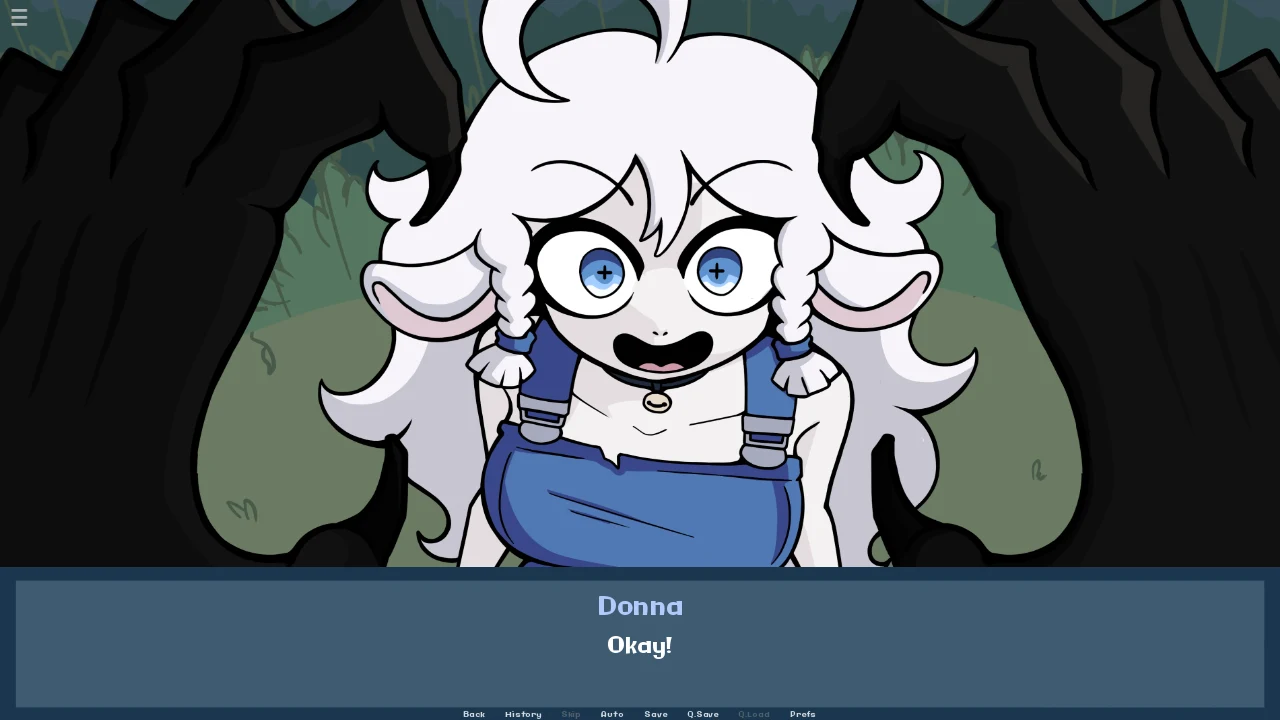
Scene screenshot: Donna smiles in the same forest, and her dialogue reads 'Okay!' The bottom toolbar shows Back, History, Skip, Auto, Save, Q.Save, Q.Load, and Prefs. These are reading controls, not branching dialogue choices; their presence does not verify saving or loading.

Donna smiles in the forest and says Okay! above the reading toolbar.

Use Images and Video at the Right Time

The local cover and two scene images are woven into this guide as visual references. They are not presented as evidence for secret outcomes or as a substitute for reading the work. Images can disclose atmosphere, characters, or interface details even without a written spoiler. If you prefer to discover the presentation for yourself, play first and revisit the illustrated sections afterward.

Two supplied videos offer another optional way to see material associated with the game. We do not call them official trailers or certify that their footage matches this hosted build. Watching may reveal more of the story than you intended. Decide whether your goal is troubleshooting, revisiting a moment, or seeing a full presentation before pressing play, and avoid having the video and game audio run over one another.

If you compare footage with your session, describe concrete differences rather than drawing immediate conclusions about missing content. A different platform, setting, or recording choice could explain a visual change, but none is confirmed simply by noticing it. Useful comparison starts with what is visible. This keeps a practical reference from becoming an accidental source of invented features, unsupported release claims, or unnecessary spoilers.

Leave with a Reflection, Not a Completion Score

A second pass through a linear novel can still be rewarding. Once you know the sequence, your attention can move from what happens next to how the presentation guides expectations. Consider whether an ordinary phrase now feels different or whether a pause carried more weight than you noticed initially. You are rereading the same work with changed knowledge, not farming a hidden achievement.

If the remote player fails, note the visible error and try a measured recovery such as checking connectivity or reloading once. Do not disable security protections broadly or assume that repeated clicks will fix a host problem. A direct link to the same build can help separate frame restrictions from a wider loading failure, but it remains third-party content. Official desktop availability is a distinct option, not a guarantee about the web copy.

Finally, credit Demonward and separate your reaction from the game's stated facts. A concise recommendation might explain that it is a short, linear horror reading experience involving Donna and Oz, with the known content themes and a spoiler warning where necessary. There is no need to promise an ending, a moral lesson, or a universal emotional response. Respecting those limits leaves the next reader room for an experience of their own.

Best Friends for Dinner Videos

Best Friends for Dinner FAQ

What kind of experience should I expect?

A brief, linear kinetic visual novel by Demonward, rather than a branching relationship simulation.

Can I change the outcome through this page?

No. The companion checklist does not connect to the game's narrative or save data.

How much time should I allow?

Around five minutes is the supplied estimate for roughly 1,000 words. Allow more time for loading or reflection.

Is Oz a wolf?

Yes. The supplied character information identifies Donna and the wolf Oz.

Is this suitable for a lighthearted reading break?

Review the warnings first: implied violence, poisoning, exclusion, and black humor may be uncomfortable.

Am I playing Demonward's official web release?

No. The official version is desktop-based; the embedded browser conversion is third-party.

Are the videos necessary?

No. They are optional and may reveal story material; their equivalence to this build is not verified.

Will progress survive a refresh?

Game persistence has not been verified. The separate preparation checklist resets when the page is refreshed.